


Senior Kindergarten (SKG) Program
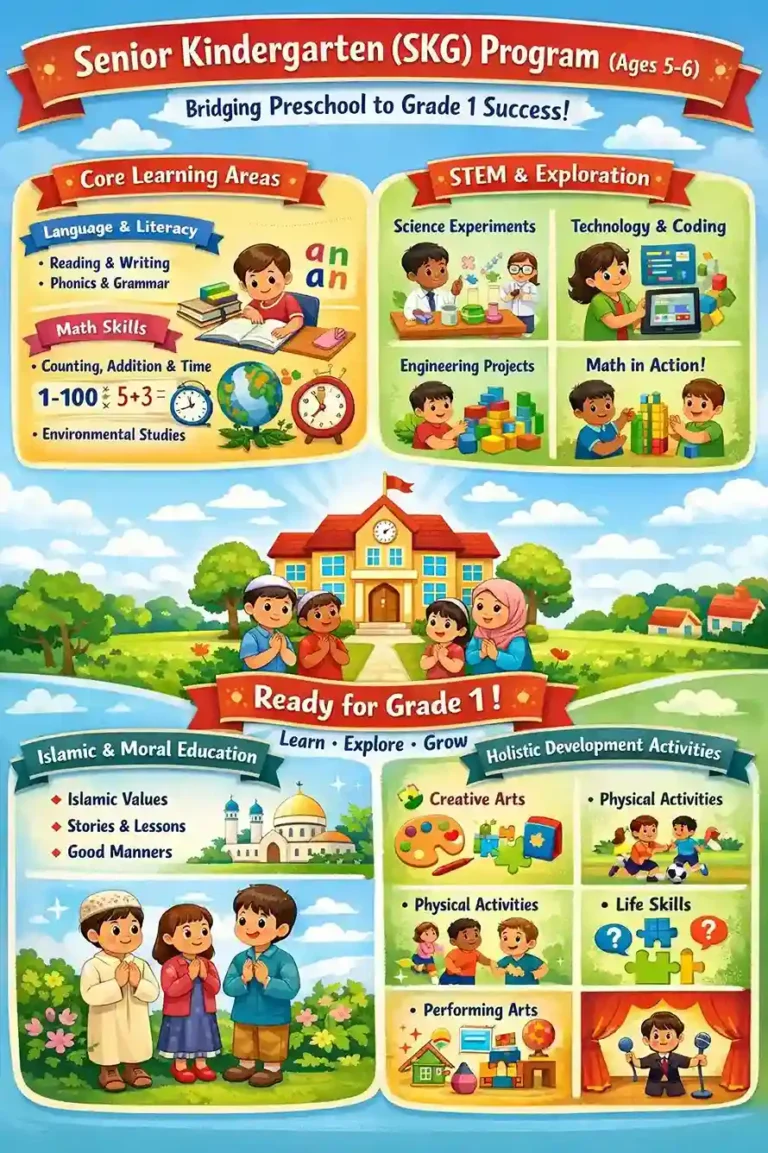
Senior Kindergarten (SKG) Program (Ages 5-6)
The SKG program serves as a critical bridge between preschool and formal primary schooling (Grade 1). It places a stronger emphasis on literacy, numeracy, and critical thinking to ensure children are ready for a smooth transition.
A. Core Learning Areas
Language and Literacy:
– Reading: Reading simple sentences and short stories. Using phonics to decode new words. Developing comprehension by answering questions about a story.
– Writing: Writing simple words, phrases, and short sentences. Introduction to basic punctuation (capital letters and full stops). Developing creative writing skills (e.g., labeling a picture or writing a caption).
– Grammar: Introduction to basic concepts like use of ‘a/an’ and common sight words.
Mathematics:
– Advanced Counting: Counting and writing numbers 1-100. Introduction to simple addition and subtraction using objects (concrete method).
– Mental Math: Simple number sequencing and understanding the concept of tens and ones (place value basics).
– Measurement and Data: Measuring using non-standard units (hand spans, cubes), telling time (o’clock), and identifying coins.
Environmental Studies (EVS):
– Connectivity: Connecting with nature through nature walks and descriptive exploration. Understanding the interdependence of living things.
– Safety: Learning about safety rules at home, on the road, and in school.
– General Knowledge: Expanding knowledge about the country, national symbols, and the world.
B. STEM Integration Practices
In SKG, STEM projects become more complex and often integrate multiple domains. The focus is on problem-solving and perseverance.
– Science as Experimentation: Conducting simple, multi-step experiments (e.g., “What does a plant need to grow?” with control and variable plants). Exploring concepts of magnetism or color mixing.
– Technology as Research: Using a computer or tablet with guidance to look up information about an animal (with teacher assistance). Introduction to simple coding concepts through age-appropriate apps or toys (like sequencing commands).
– Engineering as the Design Process: Engaging in the full design process: Ask (a question), Imagine (a solution), Plan (draw it), Create (build it with recycled materials or blocks), and Improve (make it better).
– Mathematics as Application: Using measurement skills to build a structure, using patterns to create a piece of art, and using addition/subtraction to keep score in a game.
C. Islamic Culture/ Moral Science
In SKG, the curriculum builds on the foundation laid in JKG. Concepts are explored with slightly more depth, and there is a greater emphasis on understanding the “why” behind practices and applying moral lessons in social interactions. This level serves as preparation for more formal Islamic studies in Grade 1.
D. Holistic Development Activities
Creative Arts: Directed drawing, craft projects requiring multi-step instructions, and collaborative art projects. Following complex instructions (algorithms).
Physical Development: Brain gym exercises, fine motor activities to strengthen hand grip for writing, team sports, and basic fitness. Understanding how the body moves and works.
Life Skills: Brainy (critical thinking) activities, making choices, and developing independence in completing tasks. Decision-making and adaptability.
Performing Arts: Participating in drama, stage performances, elocutions and debates. Confidence in sharing ideas and findings.