


Junior Kidergarten (JKG) Program
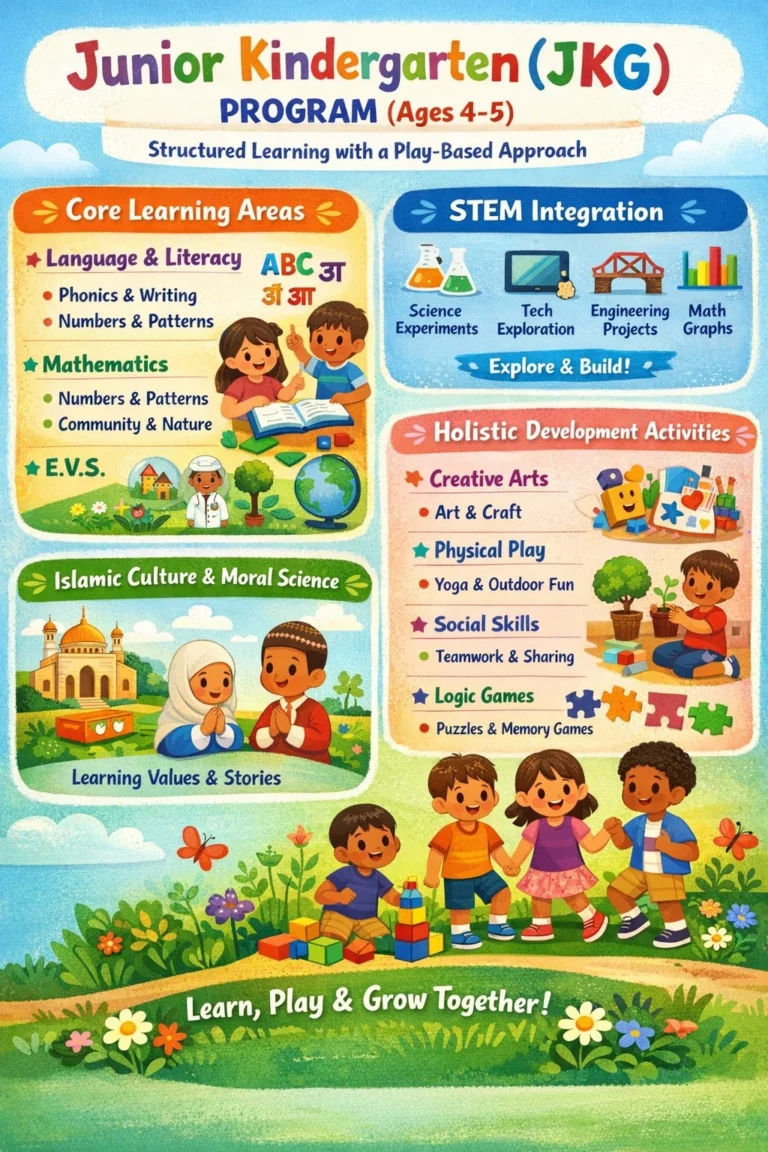
Junior Kindergarten (JKG) Program (Ages 4-5)
The JKG program builds on the foundational skills of Nursery by introducing more structured learning in literacy and numeracy, while still maintaining a play-based approach. The curriculum fosters greater social interaction and logical thinking.
A. Core Learning Areas
Language and Literacy (English & Hindi):
– Reading Readiness: Mastering letter recognition (both capital and small letters). Linking letters to their corresponding sounds (phonics) more formally.
– Writing: Moving from patterns to writing letters and simple three-letter words (CVC words like c-a-t). Children may begin writing their own names.
– Communication: Engaging in show-and-tell activities, describing everyday objects, and following simple instructions.
Mathematics:
– Number Operations: Identifying numbers 1-50, writing numbers 1-20, and understanding the concept of quantity.
– Logical Thinking: Introduction to simple patterns (AB, ABC patterns), sequencing (what comes before/after a number), and sorting by multiple attributes.
– Spatial Understanding: Understanding positions like in/out, up/down, and on/under.
-Environmental Studies (EVS):
– Social World: Learning about community helpers (doctors, teachers, policemen) and different festivals.
– Natural World: Differentiating between types of animals (domestic/wild), plants, and seasons. Introduction to basic concepts of weather.
B. STEM Integration Practices
In JKG, STEM learning becomes more intentional and inquiry-based. Children are encouraged to hypothesize and investigate.
– Science as Inquiry: Simple experiments like sinking and floating in water, or planting a seed and observing its growth. Exploring the concept of ramps and motion with toy cars.
– Technology as Documentation: Using a tablet or camera (with supervision) to take pictures of their block structures or plants they are growing.
– Engineering as Design: Building bridges or enclosures with blocks. Engaging in “tinkering” with loose parts to create something new.
– Mathematics as Data: Creating simple picture graphs (e.g., “What is your favorite fruit?”) and counting the results.
C. Islamic Culture/ Moral Science
-In JKG, the focus is on creating positive associations with Islamic concepts. Children are introduced to the basics of faith through sensory experiences, stories, and simple routines. The emphasis is on “Tarbiyah” (nurturing) and familiarization
D. Holistic Development Activities
-Creative Arts: Collage making, craft activities related to themes, drawing with more detail, and using scissors for cutting. Developing fine motor control for writing and tool use.
-Physical Development: Yoga for young children, simple exercises, free hand walking on a line, and more complex outdoor play (throwing/catching). Body awareness and spatial reasoning.
-Social-Emotional: Participating in group games with rules, taking turns in conversations, and expressing feelings appropriately. Teamwork in engineering challenges.
-Logic Skills: Solving simple puzzles, matching games, and memory games. Core computational thinking skills.