


Nursery Program
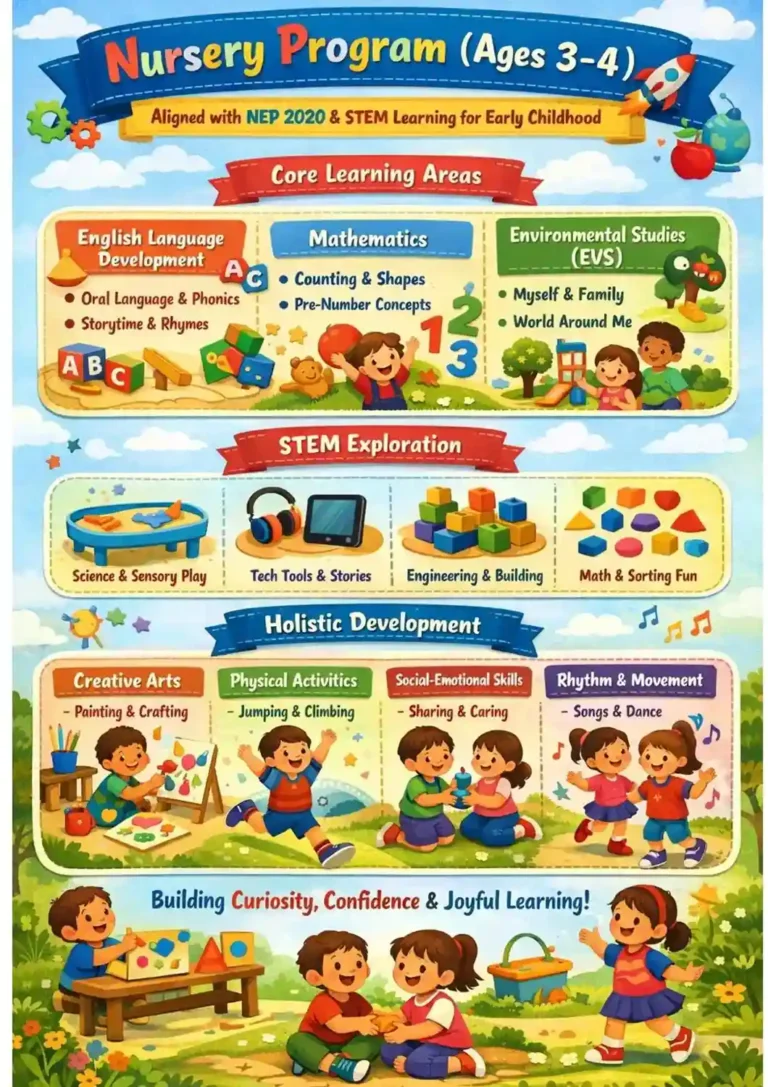
The program is structured to align with the guiding principles of the National Education Policy (NEP) 2020, and the pedagogical best practices of STEM (Science, Technology, Engineering, and Mathematics) education in early childhood. The philosophy is rooted in play-based, inquiry-driven learning that fosters holistic development -cognitive, social-emotional, physical, and creative—while building foundational literacy and numeracy.
Nursery Program (Ages 3-4)
The Nursery program is designed as a gentle transition from home to school. The primary goal is to develop a sense of security, independence, and curiosity. The focus is on developing fine and gross motor skills, sensory exploration, and oral language.
A. Core Learning Areas
English Language Development
– Oral Language: Focus on listening and speaking skills through storytelling, rhymes, and conversations. Children learn to recite simple rhymes and identify objects.
– Phonological Awareness: Introduction to letter sounds (phonics) and the association of sounds with objects (e.g., “a” for apple).
– Pre-Writing Skills: Development of fine motor control through pattern writing-standing lines, sleeping lines, curves, and zigzags. This prepares the hand for letter formation.
Mathematics
– Pre-Number Concepts: Understanding comparisons like big/small, tall/short, more/less, empty/full.
– Counting and Numbers: Rote counting and object recognition of numbers from 1-10 or 1-20.
– Shapes and Colors: Identification and sorting of basic shapes (circle, square, triangle) and primary colors.
Environmental Studies (EVS)
– Myself and Family: Identifying body parts, learning about family members, and practicing good personal hygiene.
– World Around Me: Exploring common animals, birds, fruits, vegetables, and modes of transport through pictures and real-life objects.
B. STEM Integration Practices
At the Nursery level, STEM is about sensory exploration and observing cause and effect.
– Science as Exploration: Sensory play with sand and water to explore textures and flow. Observing light and shadow during outdoor time or through simple shadow puppets.
– Technology as Tools: Using audio-visual aids to listen to rhymes and watch simple stories. Learning to operate simple mechanical toys.
– Engineering as Building: Using large blocks to stack and build simple structures. Solving problems like “how can we make this tower not fall?”.
– Mathematics as Logic: Sorting objects by color or size during clean-up time. Simple pattern-making with beads or blocks.
C. Holistic Development Activities
-Creative Arts: Free drawing and coloring with crayons; finger painting; paper tearing and pasting; clay modeling. Exploring textures and material properties.
-Physical Development: Developing gross motor skills through running, jumping, climbing; fine motor skills through puzzles, threading beads, and playing with blocks. Hand-eye coordination essential for using tools.
-Social-Emotional: Learning to share and cooperate in group activities; using polite words like “please” and “thank you”. Collaborative problem-solving in play.
-Rhythm & Movement: Learning simple rhymes in English and Hindi/Urdu; action songs and aerobics to develop rhythm and coordination. Understanding patterns and rhythm.